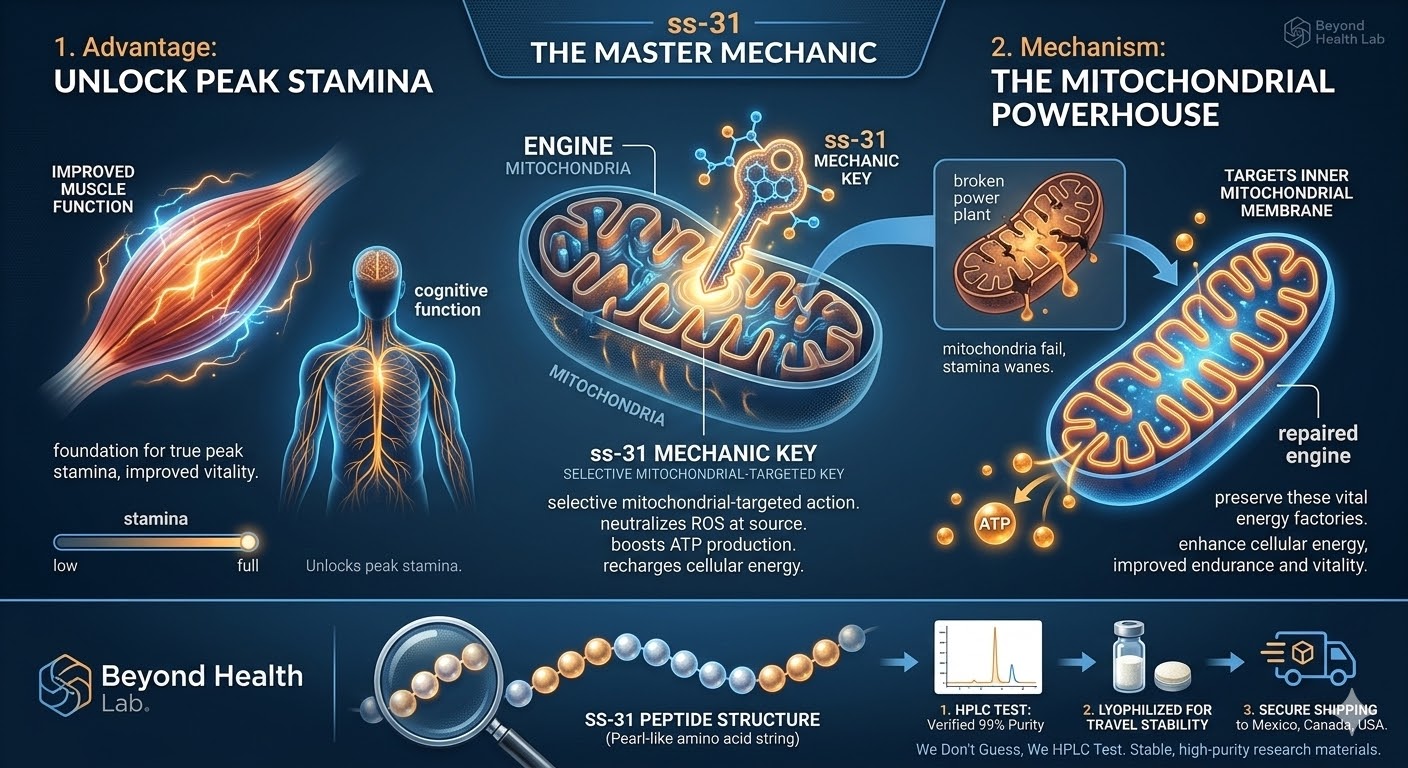
The Master Mechanic
Imagine if your body was a high-performance race car. Over time, even the best engines get dirty, rusty, and start to lose power. SS-31 is like a specialized mechanic that dives deep inside the engine to fix the parts that create energy.
Most medicines just try to hide the smoke coming from the engine, but this peptide goes straight to the source: the power plants inside your cells called mitochondria. In this guide, we will explore exactly how SS-31 helps these tiny engines run smoothly again and why scientists call it one of the most exciting discoveries for anti-aging and energy.
1: What are the Main SS-31 Peptide Benefits?
SS-31 (also known by its scientific name, Elamipretide) is a small peptide that acts like a "smart missile" for your mitochondria. Unlike other supplements that just float around in your blood, this one knows exactly where to go.
The primary SS-31 peptide benefits come from its ability to restore energy production. When our cells get old or sick, they struggle to make fuel. Researchers have found that this peptide can help fix mitochondrial dysfunction, which is just a fancy way of saying "broken power plants." Whether it’s for heart health, aging, or muscle strength, the goal of this peptide is to make sure your cells have the battery power they need to do their jobs.
2: How Cardiolipin and Mitochondrial Dysfunction are Linked
To understand how this works, we need to talk about "The Glue" that holds your engine together. Inside your mitochondria, there is a special fat called cardiolipin.
Think of cardiolipin like the curve in a race track. If the curve is smooth, the cars (electrons) can zoom around fast and make energy. But as we age, that track gets bumpy and flat. This causes the cars to crash! When the track is broken, we call it mitochondrial dysfunction.
How Does SS-31 Work?
SS-31 is the road repair crew. It binds directly to the cardiolipin and pulls it back into the perfect curved shape. By fixing the shape of the track, it allows the energy-making process to run smoothly again without crashing. This is something very few other compounds can do.
3: The Science of Oxidative Stress
When a car engine is broken, it produces a lot of black smoke. In your cells, this "smoke" is called oxidative stress (or free radicals).
Usually, a damaged mitochondria pumps out tons of this toxic smoke, which hurts the rest of the cell. Because SS-31 fixes the engine itself, it stops the smoke before it even starts. This is different from taking Vitamin C or antioxidants, which just try to fan the smoke away after it's already there. By improving ATP production (your body's fuel) and stopping the smoke, it protects the cell from the inside out.
4: Research Results: Elamipretide in Action
In scientific studies, Elamipretide has shown amazing results. In old mice, it helped their hearts beat as strongly as young mice. In other tests, it helped tired muscles keep moving for longer periods.
Mitochondrial Repair Peptides
Scientists group SS-31 into a category called mitochondrial repair peptides. While most treatments just put a bandage on the problem, these peptides try to rebuild the machinery of life. This is why researchers are studying it for serious conditions like heart failure and kidney disease—problems where the body just runs out of gas.
5: Dosage and Usage in Research
Because this is a powerful research chemical, scientists have to be very precise.
SS-31 Dosage for Anti-Aging
In animal studies, the SS-31 dosage for anti-aging is often calculated based on weight to see how it affects lifespan and energy. Researchers have found that you don't need a huge amount to see changes because the peptide targets the mitochondria so accurately. It is usually given as a subcutaneous injection (a small shot under the skin) to make sure it gets into the bloodstream quickly.
6: Safety Profile and SS-31 Side Effects
Is it safe? Because SS-31 doesn't mess with your hormones or immune system, it is considered very well-tolerated in research.
SS-31 Side Effects
The most common SS-31 side effects reported in trials are minor things like irritation at the injection spot or a slight headache. Unlike stimulants that make your heart race, this peptide works quietly in the background. However, because it is still being studied, it is not yet approved for casual use by doctors, and we are still learning about its long-term safety.
7: FAQ: Common Questions About SS-31
- Is SS-31 a steroid? No. Steroids change your hormones and build big muscles artificially. SS-31 fixes the "batteries" inside your cells so they work like they did when you were younger.
- Does it give you energy like coffee? Not exactly. Coffee stimulates your brain to make you feel awake. SS-31 improves ATP production, which means it gives your cells the actual fuel they need to function, rather than just a temporary buzz.
- Can it repair old damage? Research suggests that by fixing mitochondrial dysfunction, it can help tissues that have been "starved" of energy to recover and function better.
8: Key Takeaways
- The Target: It goes straight to the mitochondria, the power plants of the cell.
- The Glue: It binds to cardiolipin to fix the shape of the inner mitochondrial membrane.
- The Result: It boosts ATP production and stops toxic "smoke" (oxidative stress).
- The Safety: It is a targeted repair tool, not a stimulant or a hormone.
Conclusion: The Future of Energy
We used to think that getting tired and weak was just a normal part of getting older. But SS-31 is showing us that we might be able to tune up our engines and keep them running smoothly for much longer. By fixing the tiny power plants inside us, SS-31 represents a huge leap forward in helping our bodies heal themselves from the inside out.
References
- Szeto, H. H. (2014). First-in-class cardiolipin-protective compound as a therapeutic agent to restore mitochondrial bioenergetics. British Journal of Pharmacology, 171(8), 2029-2050.
- Birk, A. V., et al. (2013). The mitochondrial-targeted compound SS-31 re-energizes ischemic mitochondria by interacting with cardiolipin. Journal of the American Society of Nephrology, 24(8), 1250-1261.
- Dai, D. F., et al. (2014). Mitochondrial targeted antioxidant peptide ameliorates hypertensive cardiomyopathy. Journal of the American College of Cardiology, 58(1), 73-82.